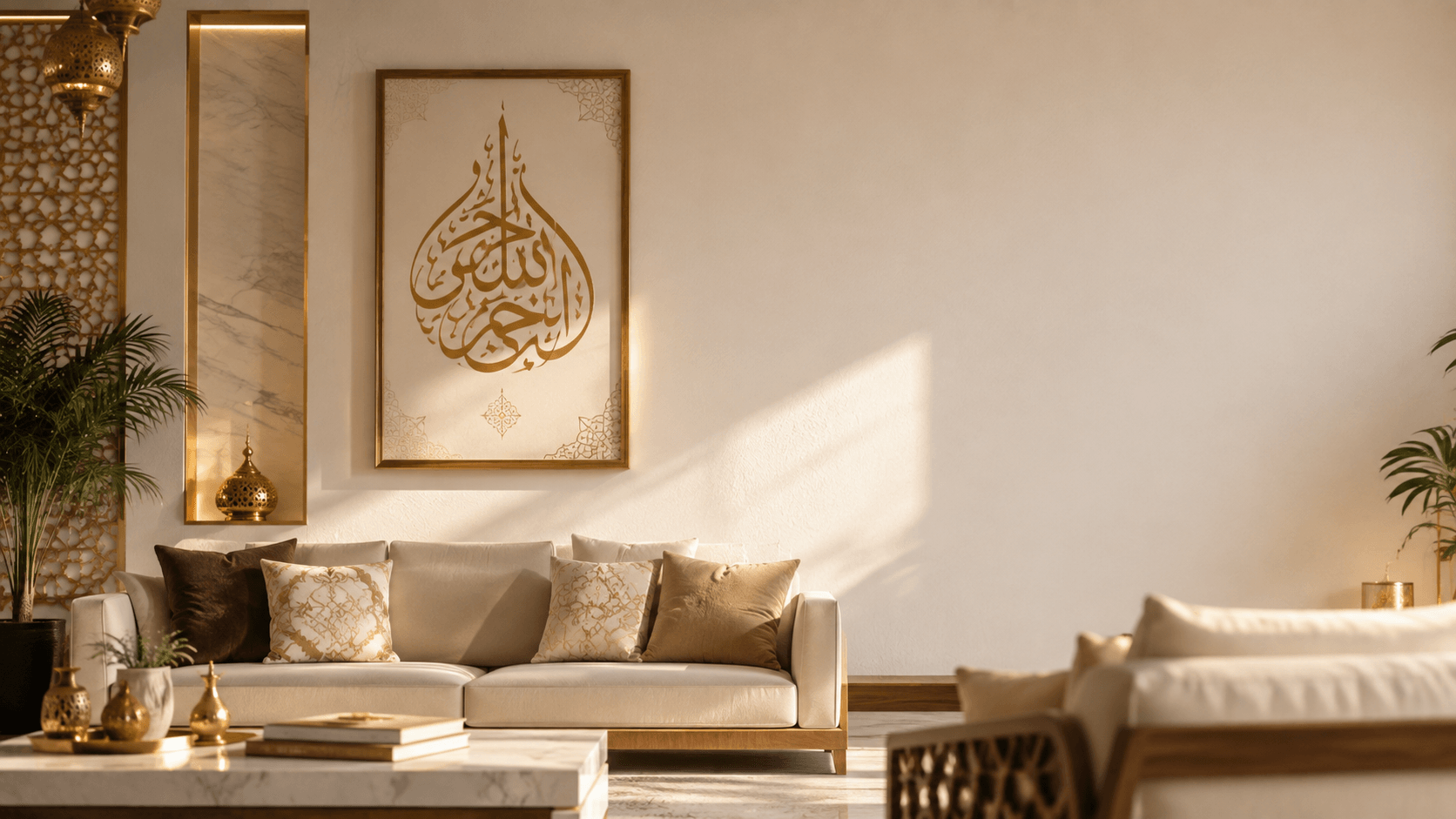
Framed Arabic calligraphy has become one of the most popular categories of home décor for Muslim households and anyone drawn to Islamic art more broadly — and unlike a lot of decorative typography, it manages to be both deeply personal and visually striking at the same time. This guide covers how to go from "I want a calligraphy print" to an actual piece on your wall, including what to write, which style fits which room, and how to get it printed well.
Choosing what to write
Common choices fall into a few categories, and it's worth thinking about which one fits the space and the feeling you want.
Qur'anic verses and duas are the most traditional choice — short, well-known verses or supplications work especially well as focal pieces since their meaning carries weight independent of the visual design. Ayat al-Kursi and short surahs are common choices for a living room or entryway.
The 99 Names of Allah (Asma ul-Husna) appear frequently as a full grid or as individual names rendered separately, often in a matching set across several frames.
Single words — Bismillah, Alhamdulillah, Mashallah — are compact, versatile, and work well in smaller spaces like a hallway or a bedside table where a longer verse would feel cramped.
Family names or personal phrases bring the same calligraphic tradition into something entirely personal — a wedding date, a family name, a phrase with private meaning — and pair well with more contemporary interior styles.
Matching style to room and mood
Naskh is the most versatile choice for wall art because it reads clearly at a glance and pairs with almost any interior style, from traditional to minimalist. It's a safe default if you're not sure which style fits.
Thuluth brings formality and visual weight, making it a strong choice for a living room, entryway, or any space meant to feel like the "main" room of the home. Its taller, more elaborate strokes reward being viewed up close.
Kufic suits modern, minimalist interiors particularly well — its geometric, almost architectural letterforms echo the same visual language as contemporary furniture and clean-lined spaces.
Diwani-inspired styles (approximated here through Thuluth-based fonts, since true digital Diwani fonts are rare) work best as a single, deliberately ornate statement piece rather than scattered throughout a home — the density of the flourishes competes with itself if overused.
From design to printed piece
Start in the Arabic calligraphy generator: type your chosen phrase, and compare it live across styles before settling on one — a verse that looks balanced in Naskh might feel cramped in Thuluth simply because Thuluth needs more vertical space per line. Once you've picked a style, use the background and color tools to test how the piece will sit against your actual wall — a design built on a transparent or white background gives you the most flexibility for framing later, while a bold color or gradient background works if the print itself is meant to be the whole visual statement rather than sitting inside a frame with visible matting.
For printing, export as SVG if you're sending the file to a print shop or having it laser-cut or engraved (wood and metal calligraphy pieces are a popular alternative to framed paper prints), since vector files print cleanly at large sizes with no loss of detail. If you're printing at home or through a standard consumer photo printing service, a high-resolution PNG (see our PNG vs SVG guide for exact resolution guidance) will work fine.
Framing and presentation tips
Leave generous white space around the calligraphy rather than filling the frame edge-to-edge — Arabic calligraphy, especially Thuluth and Diwani-influenced styles, is visually dense on its own, and negative space keeps a piece from feeling cluttered. A simple black or natural wood frame tends to let the calligraphy itself be the focal point, while ornate frames can compete with already-ornamental scripts like Thuluth. If you're creating a matched set (such as several of the 99 Names), keep the style, size, and color treatment identical across every piece so they read as a coherent set rather than a random collection.
Frequently asked questions
What's the most popular phrase for Islamic wall art?
Bismillah (in the name of Allah) and Ayat al-Kursi are consistently among the most common choices, alongside Alhamdulillah and Mashallah for smaller, single-word pieces.
Which calligraphy style is best for a modern, minimalist home?
Kufic tends to pair best with minimalist interiors because of its clean, geometric letterforms, though a simplified Naskh also works well if you want something more legible than Kufic while still keeping a clean, uncluttered look.
Can I get Arabic calligraphy wall art engraved on wood or metal instead of printed?
Yes — export your design as SVG, which most laser engraving and CNC cutting services require for clean results, and check with your specific engraver about minimum stroke width, since very fine details in ornamental styles like Diwani can be lost in the engraving process.