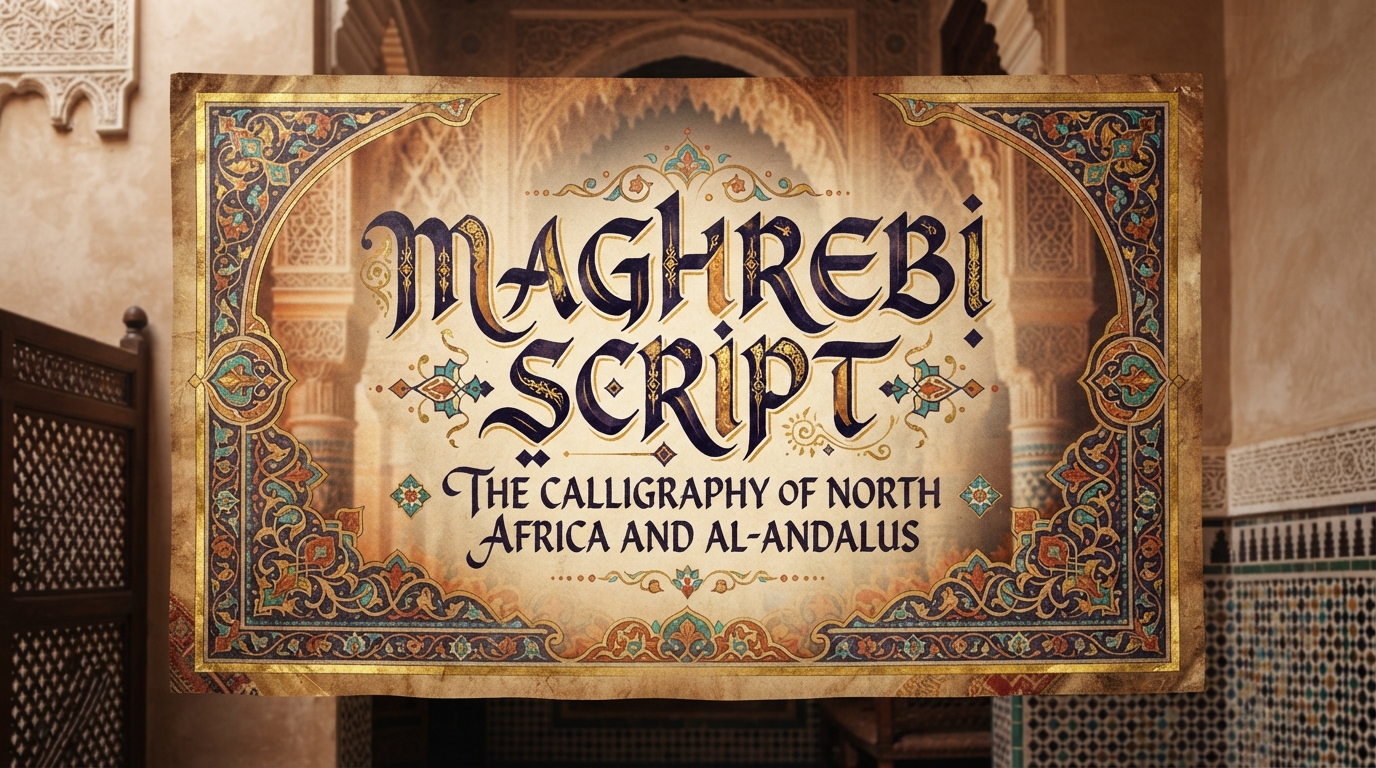
Open almost any modern Arabic font library and you'll find dozens of naskh variants, a healthy supply of kufi, and a handful of thuluth and diwani options. What you generally won't find is Maghrebi — despite it having been the everyday script of an entire quarter of the Islamic world, from Morocco to West Africa to Islamic Spain, for the better part of a millennium. It's one of the starkest gaps in digital Arabic typography, and understanding why requires going back to how the script actually developed.
A western branch of Kufic
Maghrebi script emerged in the Maghreb (western North Africa), al-Andalus (Islamic Spain and Portugal), and parts of the West African Sahel following the Islamic conquests of the region between roughly 643 and 709 CE. According to Wikipedia's overview of Maghrebi script, it developed directly out of Kufic — the same angular, early script that gave rise to most other Arabic calligraphic traditions — but along two somewhat separate regional paths: an "African" school that grew out of Kufic as practiced in Qairawan, Tunisia, and an "Andalusi" school that developed in Iberia from the Kufic used in Umayyad Damascus.
Those two regional strands then evolved together over centuries of North African and Andalusi dynastic patronage. Under the Idrisid dynasty (788–974), the script stayed close to its Iraqi Kufic roots. The Almoravid period (11th–12th centuries) spread the Andalusi variant across the wider Maghreb and produced increasingly ornate Kufic forms. Under the Almohads, professional court calligraphers turned a version of Maghrebi thuluth into something close to an official dynastic house style. By the time of the Marinid dynasty (1244–1465), the script had, in Wikipedia's phrasing, reached "its final form," fully independent of its earlier Andalusi influences.
How to actually spot Maghrebi script
Set a page of Maghrebi writing next to a page of Eastern (Mashreqi) naskh or kufic and the difference is visible even if you can't read Arabic. Britannica's entry on Maghribi script describes it as rounded rather than angular, with an "exaggerated extension of horizontal elements and final open curves below the register" — meaning certain letters trail off below the baseline in soft loops that Eastern scripts don't really use.
The letterform differences go deeper than overall silhouette. In Maghrebi script, the letter fa places its distinguishing dot below the letter body instead of above it, and qaf is written with a single dot rather than the two dots used in Eastern Arabic. Letters like sad and dad lose the small "tooth" notch that Eastern versions have. Several vertical-stemmed letters end in a small knot rather than a plain stroke. Even the writing tool differs: Maghrebi calligraphers traditionally used a pointed pen nib that produces a line of even thickness throughout, rather than the angled, chisel-cut nib used for Eastern scripts, which naturally produces thick horizontal strokes and thin verticals. That single tool difference is a big part of why Maghrebi looks softer and more uniform on the page than naskh or thuluth.
The script also isn't a single monolithic style. Historians typically divide it into several regional subscripts — a body-text form similar to Eastern naskh called mabsout, a cursive form called mujawher once used for royal announcements and later adopted for lithographic printing, a decorative thuluth maghrebi used on book titles and mosque walls, and a slanted legal-document script sometimes called musnad. A widely cited 19th-century classification by the French orientalist Octave Houdas grouped regional hands into Qairawani (smooth and even), Andalusi (small and compact), Fasi (large and round), and Sudani (thicker and darker), reflecting just how much local variation the broader Maghrebi tradition contained.
Still the script of the Quran in parts of the Islamic west
Maghrebi script wasn't a minor regional curiosity — it was the primary script used to copy the Quran and record literature across North Africa and Islamic Spain for centuries. Surviving manuscripts in Maghrebi script span an enormous range, from a 9th–10th century Quran produced in al-Andalus or Tunisia through Moroccan and Andalusi Qurans dating from the 13th and 14th centuries, and continuing into Moroccan Quranic manuscripts from the 17th and 18th centuries.
That tradition didn't stop with the medieval period. Quranic schools and manuscript traditions in Morocco and parts of West Africa have continued using Maghrebi-derived letterforms into the modern era, and the script has occasionally made headlines for reasons beyond religious scholarship — in 2020, Tunisian President Kais Saied drew media attention for issuing official handwritten correspondence in Maghrebi script, a small but symbolically loaded reminder that the tradition is still living, not purely archival.
It has faced real pressure, though. Under the French Protectorate era in Morocco, Latin script became dominant in education and administration, and Naskh-based books imported from the Mashreq (the Arab east) increasingly replaced Maghrebi-script materials in schools, shifting how an entire generation learned to write Arabic. Morocco's own Ministry of Islamic Affairs has since pushed back on that decline, establishing the Muhammad VI Prize for the Art of Maghrebi Script in 2008 specifically to keep the tradition trained and practiced. Arabic calligraphy as a whole — including regional traditions like Maghrebi — is also part of what UNESCO recognized when it added Arabic calligraphy to its list of Intangible Cultural Heritage in 2021, in a nomination that included Morocco, Algeria, Tunisia, and Mauritania among its 16 sponsoring countries.
Why it's essentially absent from digital font libraries
Given that history, Maghrebi script's near-total absence from mainstream digital type — including this site's own library of 250+ Arabic fonts — is worth explaining rather than just noting. Two structural reasons stand out.
The first is that Maghrebi's letterforms genuinely are different shapes, not just a different style applied to the same shapes. A digital Naskh, Thuluth, or Kufi font can generally build on the same underlying Arabic letterform logic and Unicode presentation-form behavior that most Arabic type design tooling and OpenType shaping engines already assume. Maghrebi's dot placement on fa, its single-dot qaf, its toothless sad and dad, and its knotted stem endings aren't decorative variations on those same standard shapes — they're a genuinely separate regional letterform tradition, closer to a dialect of the script than a font weight. Building a proper Maghrebi typeface means designing and correctly substituting a meaningfully different glyph set, not restyling an existing one.
The second reason is simply market size relative to effort. Naskh, Kufi, and Thuluth serve the entire modern Arabic-reading world, from Gulf branding to Levantine publishing to religious text throughout the Mashreq, which is more than enough demand to justify the significant investment a serious Arabic typeface requires. Maghrebi's active user base is comparatively concentrated in parts of Morocco, Mauritania, and pockets of Quranic education, which has historically made it a lower priority for commercial type foundries even though the script's historical and cultural weight is enormous. The result is a real, well-documented Arabic calligraphic tradition that most readers of a modern Arabic-language website have simply never seen rendered as a font.
Where that leaves designers today
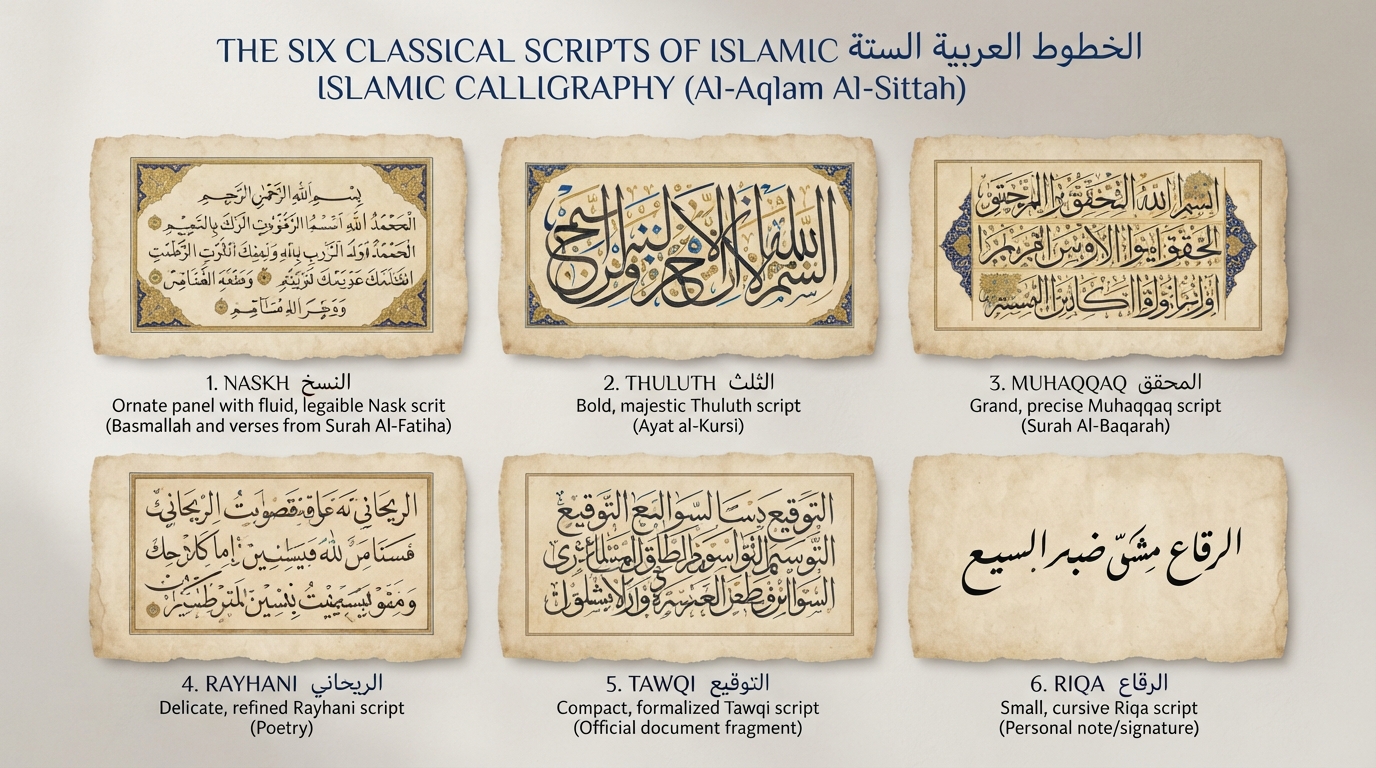
If a project specifically calls for Maghrebi script — Quranic material aimed at a North African audience, or design work rooted in Andalusi or Moroccan visual identity — the honest answer is that off-the-shelf digital options are limited, and specialist or custom lettering is often the more accurate route. For the scripts that are well represented digitally, this site's generator is the fastest way to compare how kufi, naskh, and thuluth actually render side by side. For more context on how these regional and historical script families relate to each other, see this site's guides to the six classical scripts of Islamic calligraphy and Kufic script in Islamic architecture, both useful for placing Maghrebi in the wider family tree it grew out of.
Frequently asked questions
What is Maghrebi script?
Maghrebi script is a family of Arabic calligraphic styles that developed in North Africa (the Maghreb), Islamic Spain (al-Andalus), and parts of West Africa after the Islamic conquests of the region. It evolved from early Kufic script but developed rounded letterforms and extended horizontal strokes distinct from Eastern Arabic scripts.
How is Maghrebi script different from Naskh or Kufic?
Maghrebi uses rounded rather than angular letterforms, extended horizontal strokes, and open curves below the baseline. Specific letters are also shaped differently, such as placing the dot below rather than above the letter fa, and writing qaf with one dot instead of two.
Is Maghrebi script still used today?
Yes, though on a smaller scale than Eastern scripts. It remains in use in parts of Morocco, Mauritania, and West Africa, particularly in Quranic education and manuscript traditions, and Morocco has established prizes and preservation initiatives specifically for the script.
Why aren't there more Maghrebi digital fonts?
Maghrebi's letterforms are genuinely different shapes from standard Eastern Arabic letterforms, not just a stylistic variation, so building a proper Maghrebi font requires designing a distinct glyph set rather than restyling an existing one. Combined with a comparatively smaller modern user base than Naskh, Kufic, or Thuluth, this has made it a lower priority for most commercial type foundries.
Was Maghrebi script used to write the Quran?
Yes, extensively. Surviving Quranic manuscripts in Maghrebi script date from as early as the 9th and 10th centuries through the 17th and 18th centuries, and the script remains associated with Quranic education in parts of North Africa today.