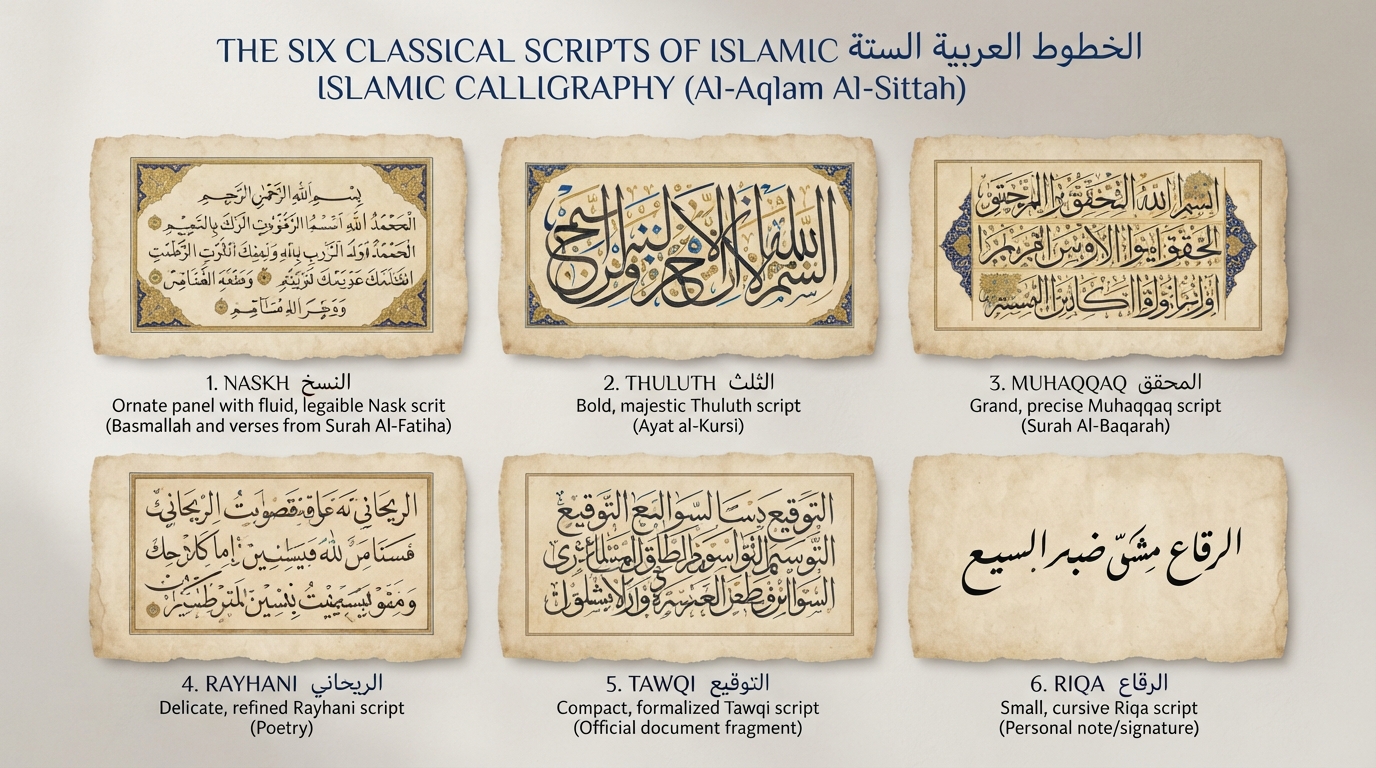
Ask a historian how many "real" scripts exist in classical Arabic calligraphy and you'll get a specific answer: six. Not seven, not a dozen — six scripts, known collectively as al-aqlam al-sittah ("the six pens"), form the traditional canon that classically trained calligraphers are still measured against. It's a narrower list than the modern style categories most font sites — including this one — use day to day, and understanding the gap between the two explains a lot about how Arabic calligraphy actually developed.
The six pens
According to the Metropolitan Museum of Art's Heilbrunn Timeline of Art History, the classical canon consists of Naskh, Thuluth, Muhaqqaq, Rayhani, Tawqi', and Riqa' — six scripts codified between the 10th and 13th centuries under a shared geometric proportioning system credited to the calligrapher Ibn Muqla, refined by Ibn al-Bawwab, and later fully codified and taught by the 13th-century calligrapher Yaqut al-Musta'simi, who trained a generation of calligraphers who carried the six styles forward after him. Every letter in every one of the six scripts was measured against the same three units: a rhombic dot made from one stroke of the pen, the height of the letter alif, and a circle whose diameter matches that height. That shared measuring system is what makes them a canon rather than just six unrelated styles that happen to be old.
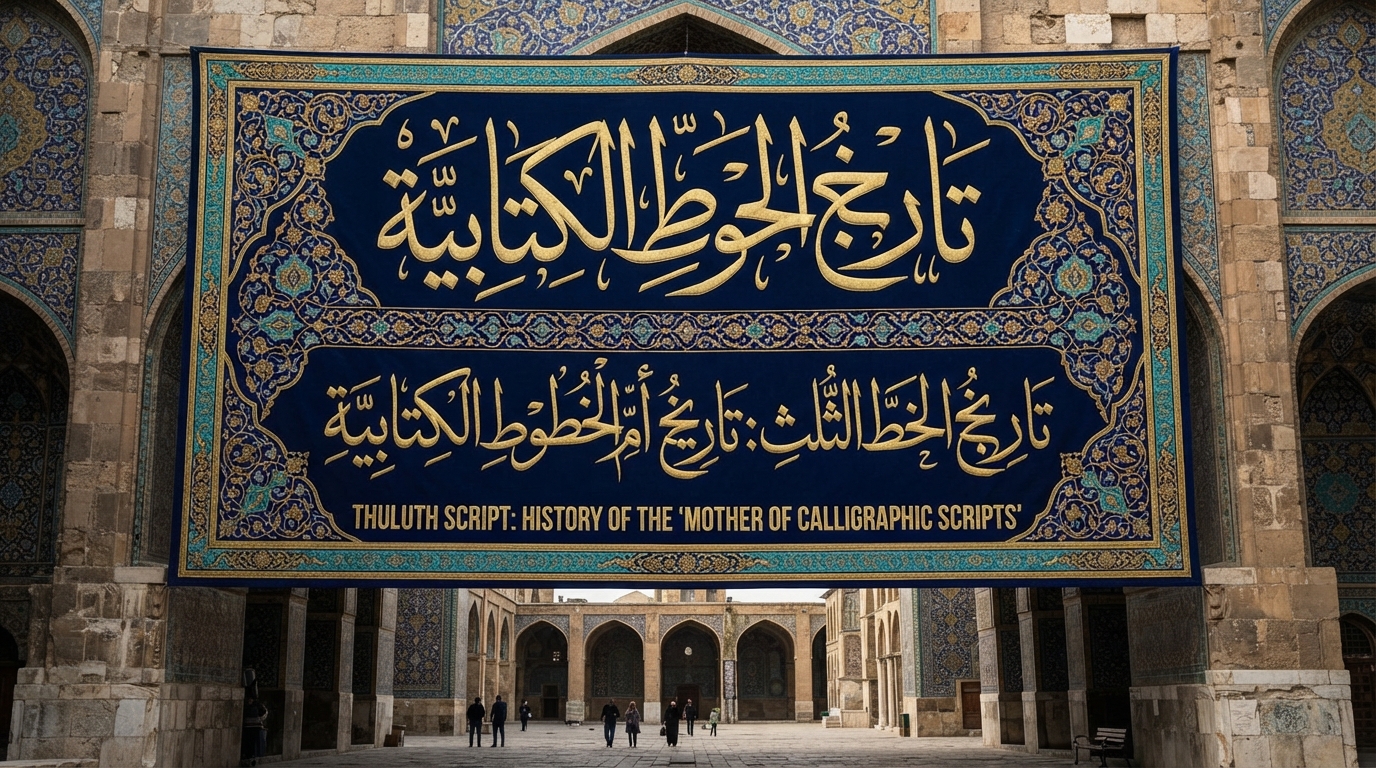
Thuluth — the technical standard
Thuluth is large, curved, and deliberately demanding — letters slant, stack, interlace, and extend well above and below the baseline. It was never meant to be fast to write, which is exactly why it became the script of titles, mosque inscriptions, and monumental work, and why calligraphers traditionally call it umm al-khatt, the "mother of scripts."
Naskh — the working hand
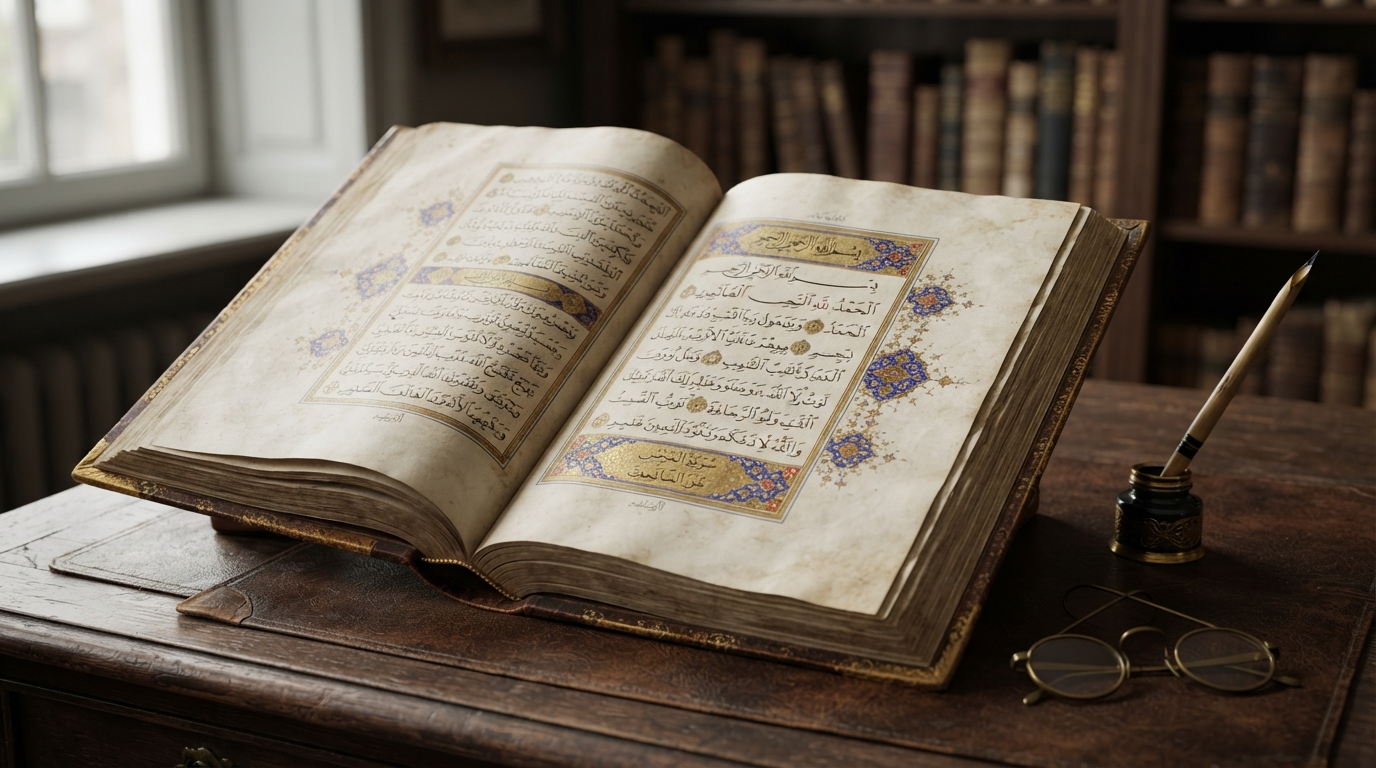
Naskh is Thuluth's opposite: compact, evenly spaced, and built for legibility at length. Its name comes from the Arabic word for "copying," and it became the standard script for Qur'ans, books, and correspondence starting around the 11th century — a role it never really gave up. It's the basis for most Arabic body-text webfonts today.
Muhaqqaq — the monumental Qur'an hand
Muhaqqaq, whose name means roughly "consummate" or "clear," was prized for its precision and difficulty. According to Wikipedia, it was regarded as beautiful but exceptionally hard to master, and it was often used to copy large-format loose-leaf Qur'ans (maṣāḥif) during the Mamluk period (1250–1517). Its use declined under Ottoman rule as Thuluth and Naskh took over most of its former roles, and by the 18th century it survived mainly in the basmala line of ceremonial calligraphic panels known as hilyas.
Rayhani — Muhaqqaq's smaller relative
Rayhani takes its name from rayhan, Arabic for basil, a reference to its light, leaf-like delicacy. Developed by Ibn al-Bawwab and later refined by Yaqut al-Musta'simi, Rayhani is essentially a finer, smaller-scale relative of Muhaqqaq, sharing its careful precision at a more compact size — closer to something usable on an ordinary page rather than a large-format manuscript.
Tawqi' — the chancery signature script
Tawqi' takes its name from the Arabic verb waqqa'a, "to sign," and the history bears out the name: it was developed for writing rulers' signatures and endorsements on official state documents, and functioned as a compressed, more rounded relative of Thuluth that could still be written with some speed thanks to extra ligatures not normally permitted in more formal scripts. Ottoman chancery scribes continued using a version of it, known as tevki, for state papers for centuries afterward, before it was gradually displaced by the more elaborate Diwani script favored in the later Ottoman court.
The scribe who fixed the canon
The six scripts existed as a working set well before any single person "finished" them, but tradition credits one 13th-century calligrapher with locking the canon into the form later generations inherited: Yaqut al-Musta'simi, a Baghdad-based calligrapher and secretary to the last Abbasid caliph. Yaqut is remembered as having codified the six basic calligraphic styles and trained the students who carried them forward after Baghdad's political and cultural upheaval in the mid-13th century — a period in which preserving and formalizing existing knowledge mattered as much as inventing anything new. He was, by tradition, extraordinarily prolific, said to have copied the Qur'an well over a thousand times across his career, and he's also credited with developing his own especially refined variation of Thuluth, known as Yakuti.
Riqa' — the everyday letter script
Riqa' — not to be confused with the later, distinct Ruq'ah script used across the Arab world today — was traditionally the script of personal letters, informal correspondence, and non-Qur'anic manuscripts: small, quick, and unpretentious compared to its five siblings. Over subsequent centuries it was gradually simplified into the modern Ruq'ah script, now the dominant everyday handwriting style across the Arab world — a direct, if distant, descendant of one of the original six.
Why the site's style categories don't match this list
If you've browsed the style pages on this site, you'll notice the modern categories — Naskh, Kufi, Ruq'ah, Thuluth, Farisi, and Modern — don't map cleanly onto the classical six. That's not an inconsistency; it reflects two genuinely different organizing traditions.
Kufic predates the six-script canon by centuries. It was already a mature, formalized script by the time Ibn Muqla began systematizing the proportioned styles, so it was never a candidate for inclusion — the canon codified what came after Kufic, not what came before it. Ruq'ah and Farisi (the basis of Nasta'liq) have the opposite problem: they're later developments. Ruq'ah, as noted above, only emerged as a simplified descendant of Riqa' well after the classical period, and Farisi/Nasta'liq developed in the Persian-speaking world along its own trajectory, blending Persian aesthetic sensibilities with Arabic letterforms rather than growing directly out of Ibn Muqla's proportioning system. Diwani, the ornate Ottoman chancery script covered in our history of Diwani calligraphy, is a similar case — it emerged centuries after the classical canon closed, inside a distinct Ottoman court tradition, rather than as an outgrowth of Ibn Muqla's system. "Modern" style categories on font sites like this one exist for a different reason entirely — they group contemporary display and branding designs by visual character rather than by historical lineage.
In short: the six classical scripts are a historical canon defined by a shared 10th–13th century proportioning system and the scribes who used it for manuscripts and state documents. The modern style categories used across font sites, including our own guide to Arabic calligraphy styles, are a practical, present-day sorting system built around what a script looks like and what it's used for now. Both are legitimate ways of organizing the same underlying tradition — they're just answering different questions: one asks where a script came from and who codified it, the other asks what it looks like on a page today and what job a designer would reach for it to do.
That distinction is worth keeping in mind if you're ever comparing sources on Arabic calligraphy and the terminology doesn't line up cleanly — a "style" in the modern, practical sense and a "script" in the classical, historical sense aren't always describing the same kind of category, even when they share a name like Naskh or Thuluth. You can see several of the classical and modern styles rendered side by side using the Arabic calligraphy generator, a fast way to get a feel for how differently these six centuries-old scripts actually behave once you set real text in them.
Frequently asked questions
What are the six classical scripts of Arabic calligraphy?
Naskh, Thuluth, Muhaqqaq, Rayhani, Tawqi', and Riqa' — together known as al-aqlam al-sittah, 'the six pens.' They were codified between the 10th and 13th centuries under a shared geometric proportioning system.
Who created the six classical scripts?
The system is traditionally credited to the 10th-century calligrapher Ibn Muqla, refined by Ibn al-Bawwab in the 11th century, and fully codified and taught by Yaqut al-Musta'simi in the 13th century.
Why isn't Kufic one of the six classical scripts?
Kufic predates the six-script canon by centuries — it was already a mature, established script before Ibn Muqla began systematizing the proportioned styles, so it developed along a separate historical track rather than being part of that later system.
What's the difference between Riqa' and the modern Ruq'ah script?
Riqa' is one of the original six classical scripts, used historically for personal letters and informal writing. Ruq'ah is a later, simplified descendant of Riqa' that developed over subsequent centuries and is now the everyday handwriting style used across most of the Arab world.