If you've ever downloaded a free Arabic font from Google Fonts, or exported a design from this site's generator, there's a good chance the font itself is licensed under the SIL Open Font License, whether or not you noticed. That's a non-issue for a personal project. It stops being a non-issue the moment that font ends up on something you sell — a product, a client's branding, packaging with your name on it. This site's guide to free vs. paid Arabic fonts covers licensing at a high level; this is the deeper legal explainer, checked directly against SIL's own OFL documentation rather than secondhand summaries.
What the OFL Actually Is
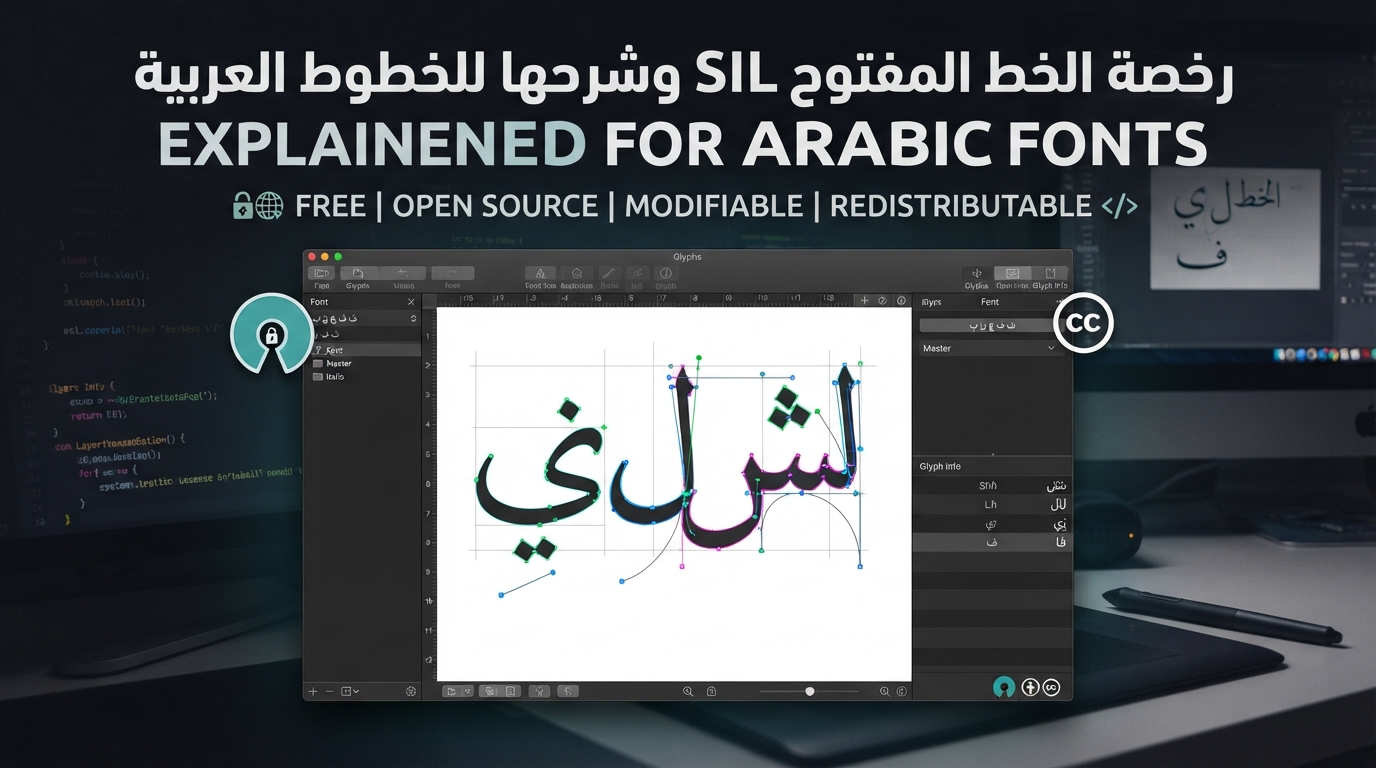
The SIL Open Font License (OFL) is a free and open-source software license written specifically for fonts, published by SIL International — the linguistics-focused nonprofit better known for the Ethnologue language database. According to Wikipedia's overview of the license, it was developed by Victor Gaultney and Nicolas Spalinger after a multi-year public review process, with version 1.1 — still the current version — released in February 2007. It's a standardized legal text, meaning the same terms apply identically across thousands of unrelated fonts rather than each one carrying its own custom license language.
What You're Actually Free to Do
The OFL is deliberately permissive. Per the official OFL FAQ, you can use OFL-licensed fonts commercially — in books, posters, artwork, logos, and websites — with no acknowledgment or credit required. You can embed the fonts, in full or subset form, directly into a document or app, and doing so doesn't change the license of that document itself. If you distribute a font alongside your own software, only the font-derived parts of the package need to stay under the OFL; your own program doesn't have to become open source just because it ships with an OFL font.
In short: designing something commercial with an OFL font, and selling the resulting product, is exactly the kind of use the license is built to allow, and it doesn't require asking permission or paying a royalty.
What the OFL Actually Restricts
There are two restrictions worth understanding clearly, because they're the parts people get wrong in both directions — assuming OFL fonts are more restricted than they are, or less.
You can't sell the font file by itself as a standalone product. The FAQ addresses this directly: you can include an OFL font on a disk or in a package alongside other freeware or commercial content, "as long as some other font or software is also on the disk, so the OFL font is not sold by itself." SIL's stated reasoning is that the license is meant to stop people from making money purely by repackaging and reselling the free font itself — the people who should profit directly from a given font are its original creators, or anyone building something substantial on top of it, not a middleman just relisting the same file.
Modified fonts can carry naming restrictions through Reserved Font Names. A font's original author can declare specific words as a Reserved Font Name in the license text bundled with the font. If someone else modifies that font and redistributes their modified version, they generally can't keep using the reserved name for it — the point is to prevent a broken or altered fork from being confused with the original, unmodified font. This only matters if you're editing and redistributing the font software itself; it has no bearing on using the font, unmodified, to produce a design.
Why Nearly Every Arabic Font on Google Fonts Uses the OFL
This isn't a coincidence. Google Fonts' own contributor documentation states the requirement plainly: to be added to the catalog, "the project must be wholly licensed under the SIL Open Font License v1.1," with no proprietary or restricted-license version of the same font allowed to exist elsewhere. Every style and weight of a family has to meet the same standard before it's accepted.
For Arabic type specifically, that requirement has mattered a lot. Building a genuinely good Arabic typeface — one that handles the joining behavior, positional forms, and diacritic placement covered in our guide to the Arabic alphabet — takes real type-design expertise, and for a long time there weren't many free, well-made options. Google Fonts' OFL requirement created a catalog where any designer, anywhere, can build on that work — embed it on a commercial website, adapt it, extend it to cover more of the script — without individually negotiating a license for each font. That's a large part of why the number of solid free Arabic webfonts has grown the way it has; our roundup of free Google Fonts for Arabic calligraphy covers a number of them directly.
Using This Site's Generator and Exports Commercially: What to Actually Worry About
Here's how this plays out for someone using our generator to build something they intend to sell:
Making a logo, product design, or piece of branded artwork with an OFL font, and selling that finished product, is exactly what the license permits. A t-shirt with calligraphy on it, a printed poster, packaging design, a business logo — these are all covered by the same "books, posters, artwork, logos, and websites" language in the FAQ. You don't owe royalties, and you don't need permission from the font's designer.
You don't have to credit the font on the finished product, though it's still reasonable practice to keep a record of which fonts you used for your own documentation, and crediting a designer whose free work you built a business around costs nothing and tends to be appreciated.
What you shouldn't do is take the raw font file itself — not artwork made with it, the actual .ttf, .otf, or .woff — and resell it as your own standalone font product, unmodified and outside of a larger bundle. That's a fundamentally different act from using the font to create a design, and it runs against the exact restriction the license exists to enforce.
If you're modifying the font's actual letterforms — customizing outlines, not just typing text with it — check the license file for any Reserved Font Names before redistributing your modified version, and rename it if the original author reserved the name.
If you're building a paid template, mockup pack, or design asset bundle that includes an OFL font as one ingredient among several — layouts, other assets, your own artwork — that's generally consistent with how the license is meant to work, since the font isn't the standalone product being sold. The line to watch is whether a buyer could reasonably extract just the bare font file from what you're selling and walk away with nothing but a repackaged copy of a free font; if the font is doing real work alongside content you actually created, you're on solid ground.
This Is General Information, Not Legal Advice
Most everyday commercial use of an OFL Arabic font — logos, products, branding, client work — falls cleanly within what the license permits, and the SIL FAQ is written in plainer language than most software licenses specifically so designers can self-serve these answers. But genuine edge cases exist: unusual redistribution models, trademark questions around a wordmark set in a particular typeface, or contracts with specific licensing clauses from a client. For anything business-critical, reading the actual OFL FAQ yourself takes a few minutes, and for a real edge case, a short conversation with an IP-savvy lawyer is worth more than an assumption. The information here reflects how the license is written and how it's commonly understood — it isn't a substitute for either of those.
Frequently asked questions
Do I need to credit the font designer when I use an OFL Arabic font commercially?
No, attribution isn't required by the license, though it's good practice to keep a record of the fonts you use, and crediting the designer whose free work you built on costs nothing.
Can I sell a t-shirt, poster, or logo made using a free Google Fonts Arabic typeface?
Yes. Using an OFL-licensed font to create artwork, and selling that finished artwork or product, is explicitly the kind of use the license is designed to allow, without needing permission or paying royalties.
Can I resell the font file itself as my own product?
No. The OFL specifically restricts selling the font software by itself as a standalone product. Using the font to make a design you sell is a different act from redistributing the raw font file as your own.
Is the SIL OFL the same as a "free for personal use only" license?
No, and this is a common misunderstanding. The OFL explicitly permits commercial use — it's the opposite of a personal-use-only restriction. The real limits are on reselling the bare font file and on renaming modified versions that carry a Reserved Font Name.