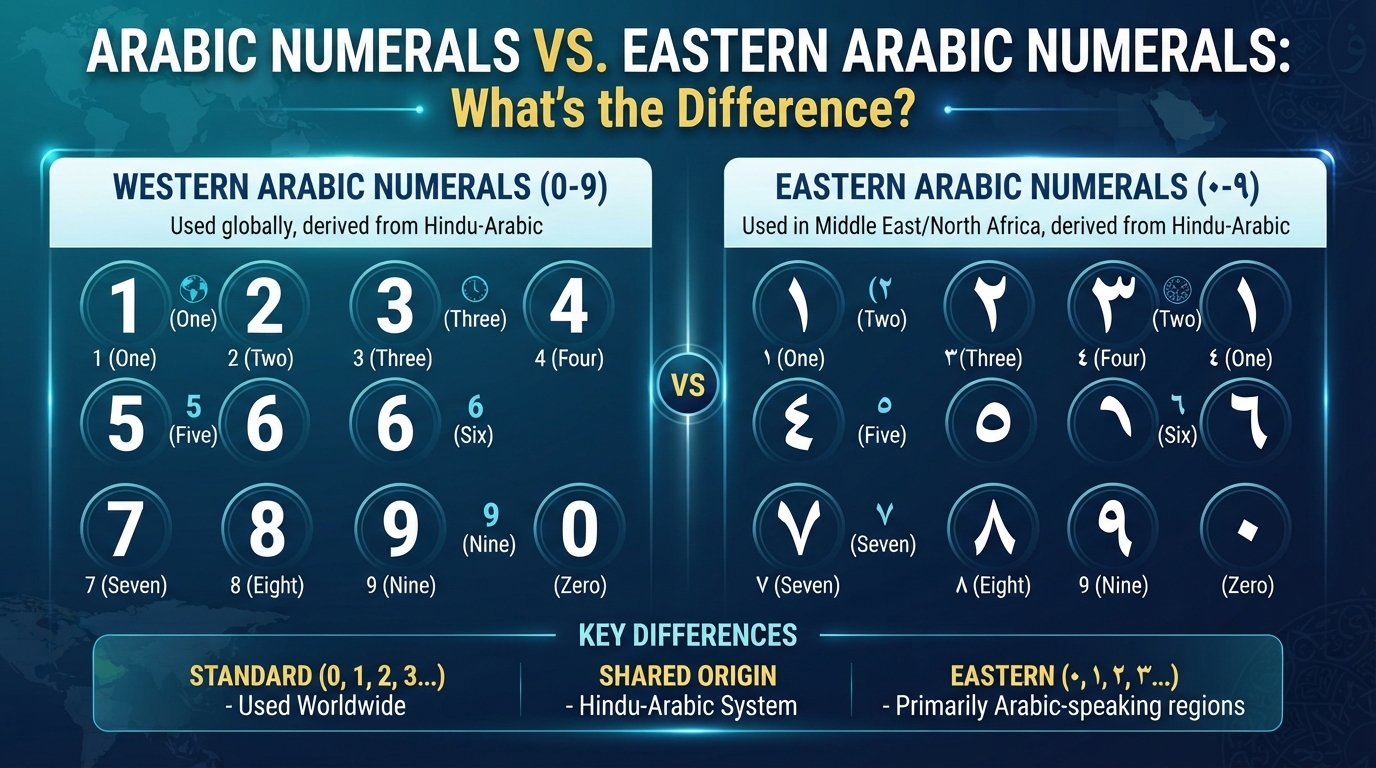
The numerals on this page — 0, 1, 2, 3, and so on — are called "Arabic numerals" in English and in most European languages. Open a newspaper in Cairo or Riyadh, though, and you'll see a visually different set of symbols for the same numbers: ٠ ١ ٢ ٣ ٤ ٥ ٦ ٧ ٨ ٩. Both systems are legitimately tied to Arabic history, but they're not the same numerals, and the real story of how Europe ended up using one version while much of the Arabic-speaking world uses another is more specific — and more interesting — than the shorthand version usually repeated online.
Where "Arabic Numerals" (0-9) Actually Come From
The positional decimal number system — where a digit's value depends on its place in the number, and a zero holds empty positions — has roots in India. According to Encyclopaedia Britannica's entry on the Hindu-Arabic numeral system, the ten symbols "originated in India in the 6th or 7th century." That system spread west during the Islamic Golden Age, when Arab and Persian scholars adopted and built on Indian mathematical work; Britannica specifically credits Middle Eastern mathematicians, "especially al-Khwarizmi and al-Kindi," with introducing the numerals into wider circulation, work that later reached Europe.
Europe's contact with these numerals came specifically through Arabic-speaking Spain and North Africa. Wikipedia's entry on Arabic numerals notes that early European exposure dates to the 10th century, with one of the earliest surviving examples appearing in the Codex Vigilanus, an illuminated Spanish manuscript from 976 CE. The numerals' popularization in European commerce and mathematics is usually credited to Leonardo Fibonacci's 1202 book Liber Abaci, written after Fibonacci studied under Arab teachers in Béjaïa, in present-day Algeria.
Because Arab scholars were the direct source Europeans learned the system from — even though the digits themselves ultimately trace back further, to India — medieval and early modern Europeans called them "Arabic numerals." Historians today more precisely call the whole lineage the "Hindu-Arabic numeral system," acknowledging both the Indian origin of the concept and its Arab transmission into Europe.
So What Do Most Arabic Speakers Actually Write Today?
Here's the part that surprises people: most Arabic-speaking countries don't use the 0-9 shapes that carry their name. Instead, everyday Arabic-script writing across much of the Middle East uses a related but visually distinct set called Eastern Arabic numerals (also known as Arabic-Indic numerals): ٠ ١ ٢ ٣ ٤ ٥ ٦ ٧ ٨ ٩.
Wikipedia's entry on Eastern Arabic numerals traces both numeral sets back to the same Indian-derived root, but the two branches developed with different glyph shapes over time. Some digits stayed closely related between the two systems — the entry notes that "1, 2, 3, 4, 5, and 9 are related in both versions" — while others, including 6, 7, and 8, ended up looking quite different between the Eastern and Western forms. Exactly when the two systems fully diverged isn't precisely documented; the oldest known Western Arabic numeral specimens appear in a 13th-century Florence manuscript, sometime after al-Khwarizmi's era, and historians generally treat the exact split as unresolved rather than pinning it to one date.
The Naming Gets Confusing, and It's Not Your Fault
Part of the confusion is baked into the terminology itself. Within the Arabic-speaking world, the 0-9 shapes used across most of Europe and the Americas are often called "Western Arabic numerals" — still "Arabic," just describing a different regional branch of the same historical family, not the numerals actually used in most Arabic-language print. Meanwhile ٠-٩ go by several names depending on the source: Eastern Arabic numerals, Arabic-Indic numerals, or simply "Arabic numerals" in a regional sense that's the opposite of how the term is normally used in English.
The cleanest way to keep it straight: "Arabic numerals," as an everyday English phrase for 0-9, describes a transmission history — how the digits reached Europe — not where they're used today. For actual current usage, "Western Arabic" and "Eastern Arabic" are the more useful, less ambiguous terms.
Visual Differences at a Glance
The two systems share a family resemblance but aren't interchangeable. Eastern Arabic numerals include distinctive shapes like a solid dot for zero (٠) rather than an oval, and a filled circle for five (٥), both quite different from the Western 0 and 5. One quirk worth knowing for design work: multi-digit numbers written in Eastern Arabic numerals still read left-to-right internally, even though the surrounding Arabic text reads right-to-left — a bidirectional-text detail that trips up software the same way it does in common Arabic typography mistakes more generally.
Where Each System Is Actually Used Today
Regional usage varies more than either "everyone uses the same numerals" or "all Arabic countries use Eastern numerals" would suggest. Based on Wikipedia's regional usage summary:
- Iran and Afghanistan predominantly use a Persian variant of Eastern Arabic numerals.
- Egypt, Sudan, and much of the Arabic-speaking Middle East and Gulf — including Iraq and the Arabian Peninsula — commonly use Eastern Arabic numerals in general Arabic-script text, though Western numerals frequently appear alongside them, especially in technical, digital, and international contexts.
- The Maghreb — Morocco, Algeria, Tunisia, and Libya — predominantly uses Western Arabic numerals (0-9) even when writing in Arabic script, a pattern generally linked to the region's longer, closer print and administrative contact with French and other European conventions during and after the colonial period.
In practice this means a document or design intended for a Gulf or Egyptian audience may look more natural set in Eastern Arabic numerals, while the identical piece for a Moroccan or Algerian audience typically reads as more familiar in the Western 0-9 forms, even though both audiences are reading Arabic script.
It's also worth noting that usage inside any one country is rarely absolute. Digital interfaces, phone numbers, and international business documents lean toward Western numerals almost everywhere, purely because that's what most software defaults to, while print media, religious texts, and handwritten or traditionally-set material are more likely to keep Eastern Arabic numerals where that's the local convention. Treat the regional patterns above as a strong default, not an unbreakable rule, and check actual examples from the target audience or region when precision matters.
Why This Matters for Typography and Design
For anyone designing in or around Arabic script, this isn't trivia — it's a real regional-accuracy decision. A restaurant menu, wedding invitation, or piece of branded calligraphy meant to feel authentic for one audience can look subtly foreign to another if the wrong numeral set is used, the same way an unexpected currency symbol or date format would. Fonts built for Arabic script generally need to support both digit sets, since a single design might need either depending on its market; this is typically handled at the font level through Unicode's separate codepoint ranges for Western digits (U+0030 to U+0039) and Arabic-Indic digits (U+0660 to U+0669), sometimes combined with OpenType localization features that let software pick the regionally appropriate set automatically.
If you're building something with numerals as part of the design — pricing on a menu, a date on an invitation, a phone number on a business card — it's worth checking which numeral system your specific audience expects rather than defaulting to whichever one happens to be easiest to type, the same way you'd check any other regional convention before finalizing a design in our generator.
Frequently asked questions
Are 0-9 really "Arabic numerals"?
The name reflects history, not current use: the positional decimal system traces to India, and Europe adopted the specific 0-9 shapes via Arab mathematicians, which is why historians call the whole lineage the Hindu-Arabic numeral system. Most Arabic-speaking countries today write with a different-looking set called Eastern Arabic numerals.
What are Eastern Arabic numerals?
Eastern Arabic numerals (٠١٢٣٤٥٦٧٨٩) are the digit forms commonly used for Arabic-script text across much of the Middle East, descended from the same Indian-derived numeral tradition as 0-9 but developed with different glyph shapes over time.
Which Arabic-speaking countries use 0-9 and which use ٠-٩?
Maghreb countries like Morocco, Algeria, Tunisia, and Libya generally use Western Arabic numerals (0-9). Egypt, Sudan, the Gulf states, Iraq, and much of the rest of the Arabic-speaking Middle East commonly use Eastern Arabic numerals, often alongside Western numerals in technical contexts.
Do Eastern Arabic numerals read right-to-left like the surrounding Arabic text?
No. Even inside right-to-left Arabic text, multi-digit numbers are read left-to-right internally in both numeral systems, which is a common source of bidirectional text bugs in software that doesn't handle mixed-direction content correctly.