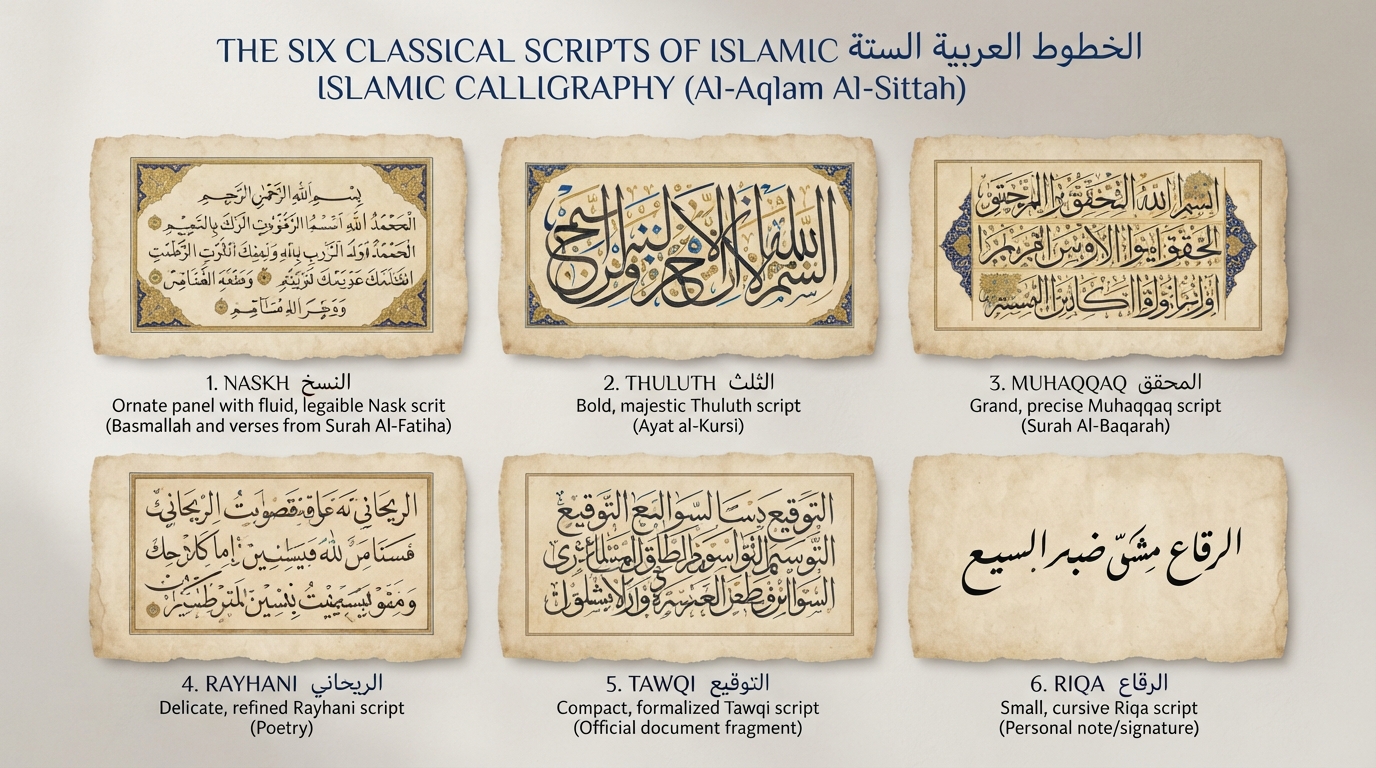
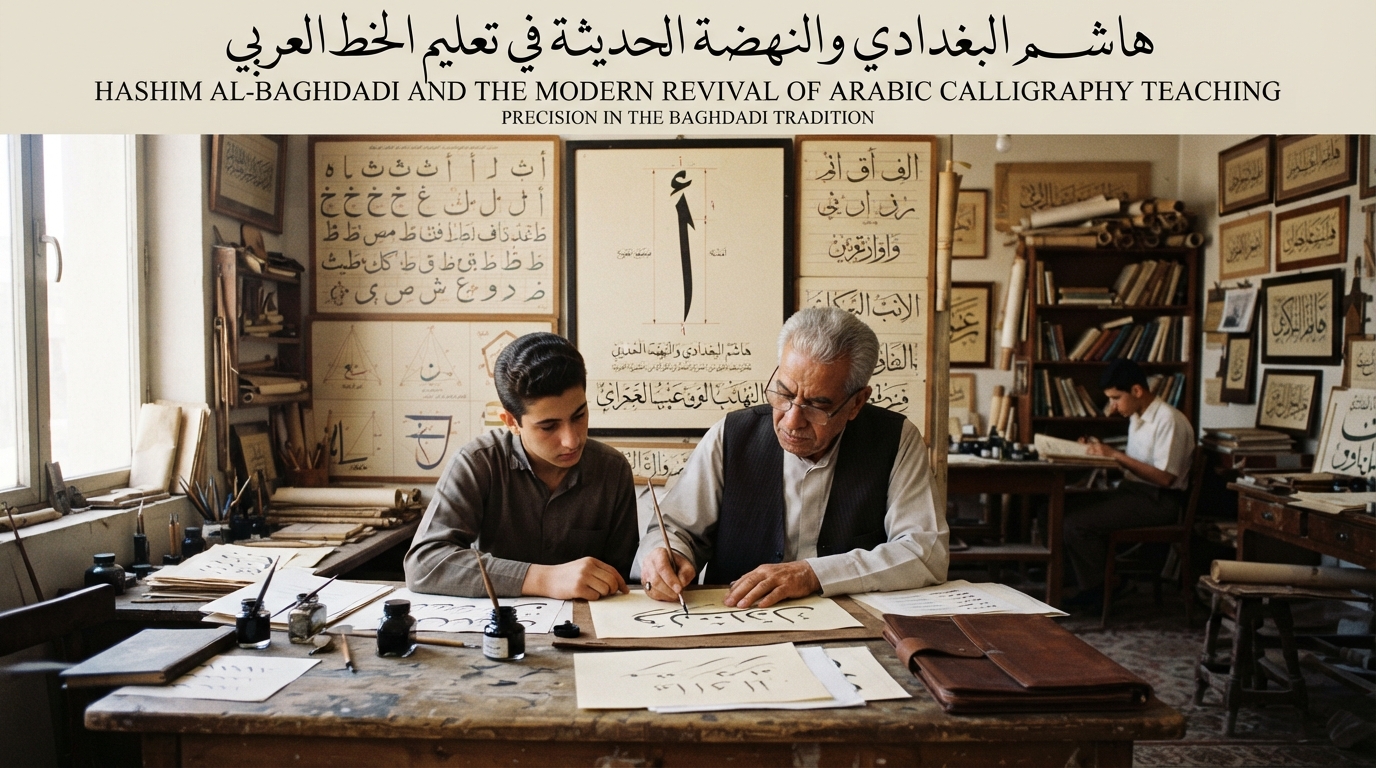
Every field has a figure who turns inherited craft into a teachable system — someone who takes centuries of scattered, master-to-apprentice knowledge and writes it down in a form the next generation can actually study from. For Arabic calligraphy, that figure is Hashim (Hashem) Muhammad al-Baghdadi. Ibn Muqla gave the craft its geometry in the 10th century; al-Baghdadi, working in 20th-century Baghdad, gave it a curriculum. Nearly every calligrapher trained in the classical scripts since the 1960s has, directly or indirectly, learned from his rules.
From map-maker to master calligrapher
Al-Baghdadi was born in Baghdad in 1917 and, according to Wikipedia, began his career in 1937 working for Iraq's Department of Public Survey producing maps — not an obvious starting point for a calligraphy career, but one that put draftsmanship and technical precision at the center of his training early on. He studied calligraphy formally under a succession of masters: Mullah Aref al-Shaikhli in Baghdad in his youth, then Mulla Muhammad Ali al-Fadli, who awarded him a diploma in 1943, and then at the Madrasat Tahsin al-Khutut (the Royal Institute of Calligraphy) in Cairo in 1944, where he trained under Sayyid Ibrahim and earned a diploma with honors.
The most consequential stretch of his education came later, in Istanbul, where he studied in 1950 and again in 1952 under Hamid Aytaç, one of the last calligraphers trained in the unbroken Ottoman master-apprentice chain that stretched back roughly five centuries. That chain matters for understanding al-Baghdadi's later influence: he wasn't just a talented independent calligrapher, he was a direct link between Iraq's classical Baghdad tradition and the Ottoman-era Turkish tradition that had, by the mid-20th century, become one of the last living repositories of the older master-to-student way of passing the craft on.
Long before he held an academic title, al-Baghdadi's work was already reaching the public at scale. In 1947 he opened a calligraphy office on Baghdad's al-Rashid Street with the painter Oksen, and the two designed newspaper headlines and currency for Iraq and, over time, for Tunisia, Morocco, Libya, and Sudan as well. That commercial and governmental work matters for the same reason his later teaching does: it meant his letterforms weren't confined to manuscripts or gallery pieces, they were the calligraphy ordinary readers across several countries encountered on a printed page or a banknote without necessarily knowing whose hand had drawn it.
Two books that became the standard curriculum
Al-Baghdadi's lasting influence rests heavily on two published works. In 1946 he published a textbook on ruq'ah script originally intended for primary schools; it proved durable enough that, per Wikipedia, it is still used in some university-level courses today. His major work followed in 1961 — a comprehensive book on the methods and rules of Arabic calligraphy, sometimes referred to as Qawa'id al-Khatt al-'Arabi ("The Rules of Arabic Calligraphy"), which systematically laid out the proportions, stroke order, and construction rules for the classical scripts in a form students could study independently rather than relying entirely on years of direct, one-on-one apprenticeship. This is the real shift al-Baghdadi represents: he didn't invent new letterforms, he took the inherited, largely oral and observational tradition running back through Ibn Muqla's proportioned system and formalized it into a text-based curriculum that could scale beyond a single master's personal workshop.
Building the department that trained a generation
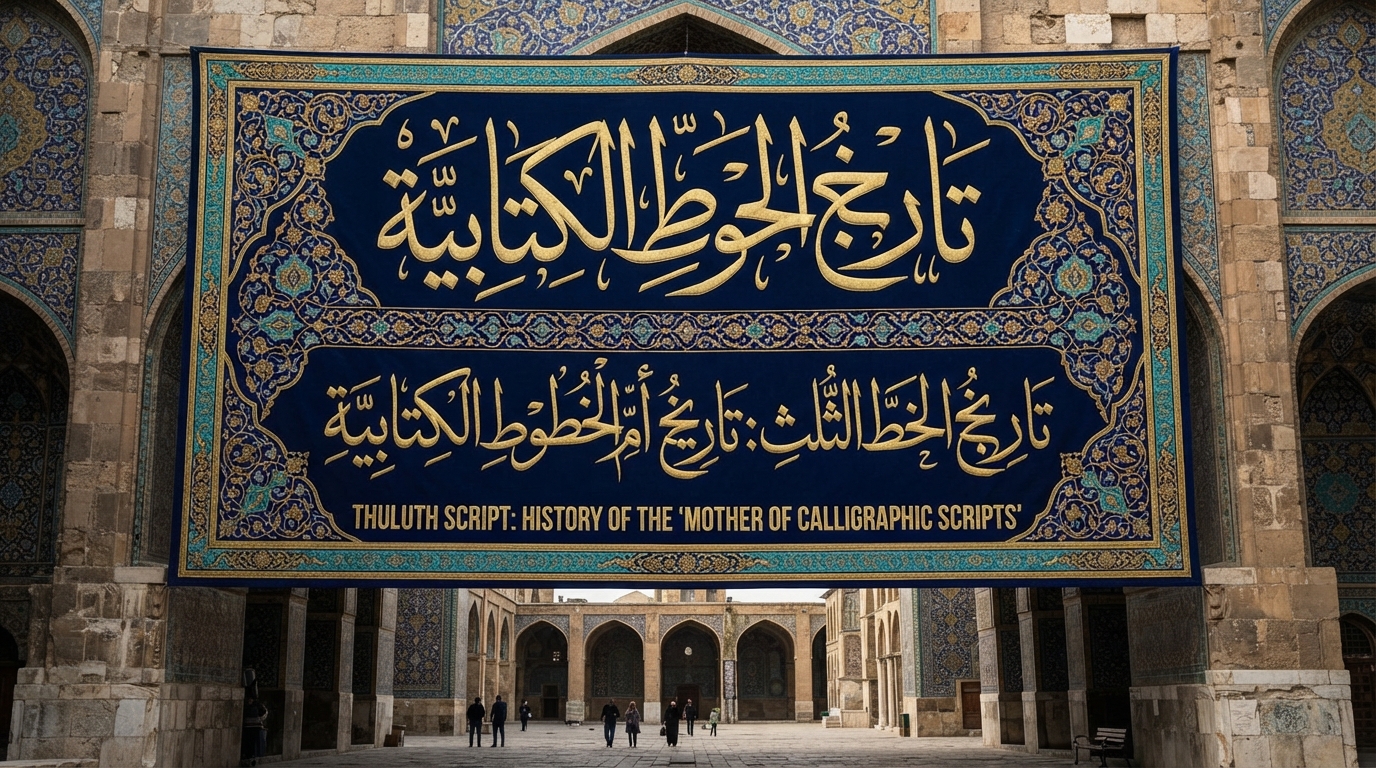
From 1960 until his death in 1973, al-Baghdadi taught at Baghdad's Institute of Fine Arts, eventually heading its Department of Calligraphy and Islamic Decoration. That position gave his teaching institutional reach a private workshop couldn't match — instead of a handful of personal apprentices, he was training cohorts of students through a structured academic program built around his own rules and methods. Among the calligraphers he certified were Walid Al-Adhami, Sadiq Al-Douri, Abd al-Ghani al-Ani, Taha al-Bustani, Jamal al-Kabbasi, and Mehdi al-Jubouri — several of whom went on to prominent careers of their own, extending his methods into the next generation. He primarily practiced Thuluth, alongside Naskh and Nasta'liq, and was noted, per Wikipedia, as the only calligrapher of his era to combine the Baghdadi and Ottoman calligraphic traditions in his own work — a natural outcome of training under both Iraqi and Turkish masters.
His public commissions reinforced the same reach: his calligraphy appears in Baghdad's al-Shahid Mosque, the Mausoleum of Abdul-Qadir Gilani, Haydar-Khana Mosque, al-Muradiyya Mosque, and Ibn Bunnieh Mosque, putting his hand — and by extension his rules — permanently into the city's public architecture. In 1971 he became a founding member of the One Dimension Group, an Iraqi art movement working to bring Islamic visual traditions, calligraphy included, into contemporary artistic practice, showing that his interest in codifying the classical rules didn't mean he saw them as frozen in place.
Why he's called the "imam of calligraphy"
Al-Baghdadi is widely referred to across the Arab world as the "imam of calligraphy," a title that reflects less any single masterpiece than the scale of his institutional and educational impact, and the fact that his written rules are still the reference point students and working calligraphers return to today. He's often described as the last of the fully classically trained calligraphers — the figure standing at the hinge between an older world where the craft passed almost entirely through personal apprenticeship, and a newer one where it could be studied from a textbook inside a university department. Hamid Aytaç himself is said to have recognized this succession directly, reportedly remarking that the line of classical calligraphy "grew up in Baghdad and ended there" as he passed leadership of the tradition to his former student. Al-Baghdadi died in Baghdad in 1973 after a heart attack; a statue was later erected in his honor at al-Fadl square in the city, and Baghdad's 2006 international calligraphy competition was dedicated to his memory.
From Ibn Muqla to al-Baghdadi to your screen
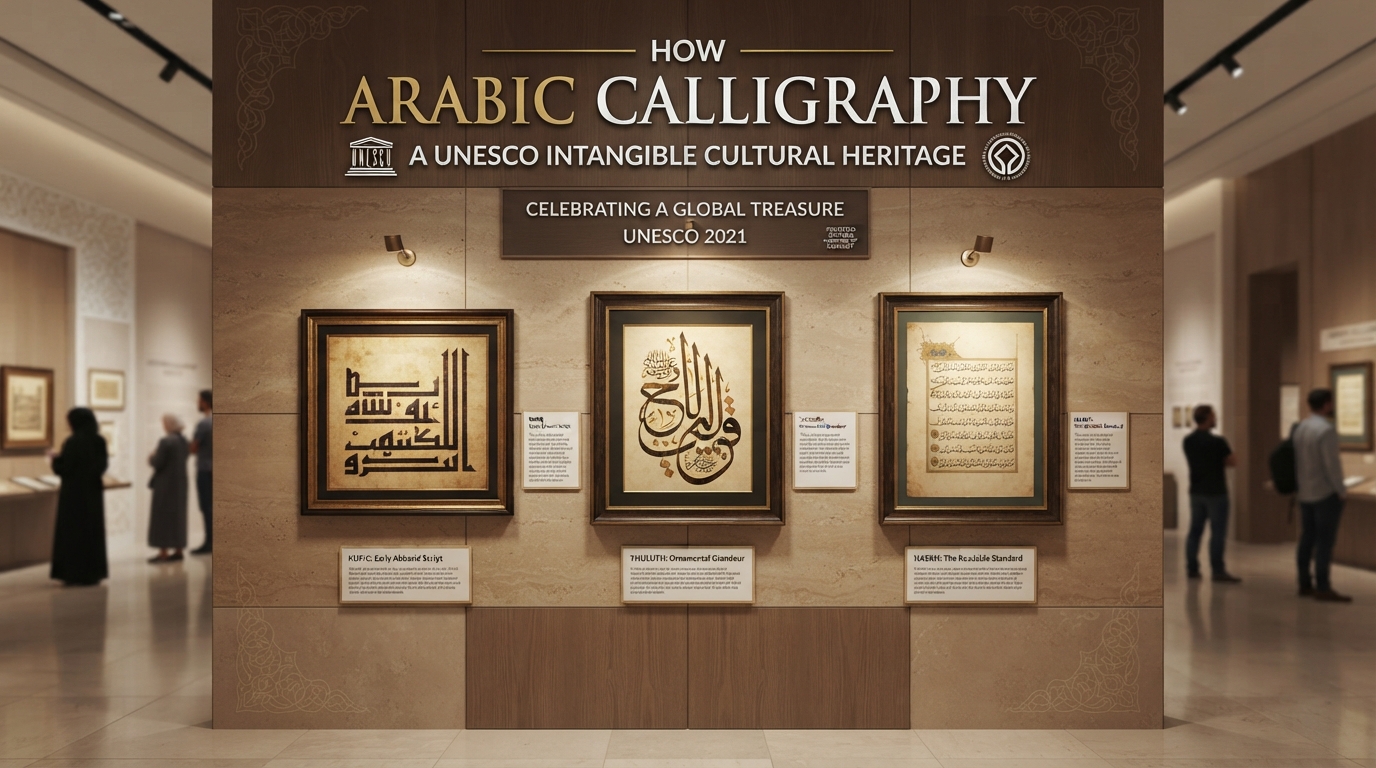
Read together, the two ends of this story are the same story. In the 10th century, Ibn Muqla worked out how to measure Arabic letterforms geometrically, turning calligraphy from raw talent into something with rules — rules covered in more detail in our piece on Ibn Muqla and the standardization of Arabic script. In the 20th century, al-Baghdadi took that same inherited rule set and turned it into a curriculum a modern institution could teach at scale, training the calligraphers who shaped how the craft is passed on today. Arabic calligraphy's UNESCO recognition in 2021 as Intangible Cultural Heritage — inscribed via a joint nomination from 16 countries — explicitly credits the practice's continued transmission from master to student, the exact mechanism al-Baghdadi worked to formalize and scale.
Every modern Naskh or Thuluth webfont, including the ones covered in our guide to the best free Google Fonts for Arabic calligraphy, ultimately traces its letterforms back through this same chain — Ibn Muqla's geometry, refined by generations of calligraphers, formalized into teachable rules by figures like al-Baghdadi, and finally digitized into the fonts you can preview right now in the Arabic calligraphy generator. If you want to go further back in that chain yourself, our beginner's guide to learning Arabic calligraphy by hand is a reasonable place to start — you'll be using rules al-Baghdadi spent his career writing down.
Frequently asked questions
Who was Hashim al-Baghdadi?
Hashim (Hashem) Muhammad al-Baghdadi (1917-1973) was an Iraqi master calligrapher, often called the 'imam of calligraphy,' who headed the Department of Calligraphy and Islamic Decoration at Baghdad's Institute of Fine Arts from 1960 until his death and wrote the rule books many calligraphers still study from today.
What did al-Baghdadi actually write?
A 1946 textbook on ruq'ah script still used in some university courses, and a major 1961 book laying out the comprehensive rules and methods of Arabic calligraphy across the classical scripts — the work most responsible for his lasting influence.
How does al-Baghdadi connect to Ibn Muqla?
Ibn Muqla developed the geometric proportioning system behind Arabic calligraphy's classical scripts in the 10th century; al-Baghdadi took that same inherited system in the 20th century and formalized it into a written, teachable curriculum, bridging roughly a thousand years of largely oral master-to-apprentice instruction into a modern academic framework.
Why is he called the 'imam of calligraphy'?
The title reflects the scale of his influence as a teacher rather than any single work — he trained a generation of calligraphers through Baghdad's Institute of Fine Arts and is often regarded as the last calligrapher fully trained in the older, unbroken classical tradition.